IMP #5. Hard Truths about the Indian PhD
A dispassionate guide from someone managing a PhD programme in International Affairs

There is a great deal of online advice for those planning to apply to PhD programmes. Most of it is for students looking abroad, to the U.S.A., Europe or Australia, for fully-funded, prestigious doctoral fellowships. These posts are full of optimism on how to secure a visa, write a statement of purpose, or network with potential advisors. There’s very little writing on what it means to apply for a PhD in India. When it does exist, it’s either promotional material or aspirational in a vague, credentialist way.
So far in this series:
Essay 1 dealt with the intellectual and emotional labour of performing critique.
Essay 2 was about the private university that does not care.
Essay 3 on what it means to defend public education.
Essay 4 looked at the politics of the personal.
This essay (part 5 in the series on academics in India) takes a different vantage point, that of someone currently managing a PhD programme at a private university in India, thinking about advising applicants, designing doctoral coursework, and helping restructure a programme’s internal academic systems after a thesis had to be rejected. The goal is to be analytically honest about how and why the Indian PhD is structurally broken, and also why that fact should not discourage serious students. A PhD is not a formality, or a stepping stone to employment mobility. It can be the beginning of a real intellectual project rooted in this place.
What Universities Often Won’t Tell You
Many Indian universities do not do the work of explaining to applicants what a PhD entails. They often provide vague descriptions, conduct formalistic interviews, and rely on entrance exams such as the UGC-NET or their own written tests. The assumption is that the process itself will select the “right” candidates. But this is a filtering system, not a pedagogical one.
Take the UGC-NET. It is a qualifying exam that many institutions use to automatically shortlist applicants. But clearing the NET says nothing about your ability to read carefully, write a proposal, or construct a research puzzle. These exams are designed to exclude those who don’t qualify, not to include the best candidates, something even higher education administrators acknowledge. This is a gatekeeping mechanism, not a pedagogical one. And so, NET-cleared candidates, even UPSC aspirants, often appear with no writing experience and no serious research interests, but with a lifetime of having topped exams. They are sometimes shocked at not being selected.
Meanwhile, the university itself maybe subject to opaque decision-making. Selection lists are routinely overruled by higher authorities for non-academic reasons. Those running the programme are exhausted from interviewing dozens of applicants who haven’t been prepared for what a research degree demands, and then demoralised by having the shortlist ignored.
Students are Often Unprepared for Academic Life
Many prospective PhD students in India are not just undertrained, but also unready for the intellectual loneliness, the emotional toll, and the institutional inertia of Indian academia. They arrive from M.A. programmes where writing is often derivative or purely descriptive, and where political awareness is mistaken for research acumen. When asked to produce original work, they rely on narratives or frames borrowed from journalistic media. There is a confusion between being “informed” and being able to craft a research question.
This gap becomes clear during coursework. For many students, it is the first time they are asked to read a journal article deeply and analytically. For others, it is the first time they receive serious feedback, and they don’t know what to do with it. Feedback is often taken personally, especially by students already under stress, with mental health challenges that universities are ill-equipped to respond to. Faculty are often torn between honesty and gentleness. I tend toward the latter which may seem like an act of care, but it becomes an obstacle to growth. I have seen the former, which accentuates paralysing self-doubt.
Misunderstanding the PhD
A growing subset of applicants treat the PhD as a flexible professional credential, something to be added to an already busy portfolio of work and teaching, often without real time for reading or reflection. These are not always bad applicants. They are often sharp, politically engaged, and articulate. But doctoral training demands that students reorient their priorities, toward intellectual depth, sustained inquiry and long-form writing, rather than expecting the PhD to accommodate their existing professional goals. When faced with the demands of coursework, they are surprised that academic rigour is non-negotiable.
At the other end of the spectrum are younger applicants who believe the PhD is a continuation of their exam success. Some respond poorly to feedback, especially when they have no experience of writing or being critiqued seriously. Others bristle at the idea of having to prove themselves beyond the interview. When asked to revise their proposals, they interpret it as rejection or humiliation.
These reactions reflect a broader crisis of expectations. Doctoral training cannot succeed unless applicants are open to intellectual vulnerability, long-form discipline, and mentorship. And universities must create systems that clarify this from the beginning.
Credentialism and the Pressure to Publish
There is no shortage of ambition. But that ambition is often distorted. Students are told to publish in "SCOPUS-indexed” journals, without understanding what that means or why it matters. Universities, under pressure from rankings and audits, reinforce this by insisting students publish multiple times before submission. The result is not better research, but a growing ecosystem of predatory and low-quality journals.
One frequent consequence is the push toward fieldwork-heavy projects, not because the research question demands it, but because field-based data collection is often seen as easier to publish, particularly in policy-adjacent journals. I have had undergraduates and master’s students approach me to do internships or collect data in exchange for a recommendation letter. When I ask what they want to work on, the answer is often vague. This signals a deeper structural problem: research becomes a transaction, a way to secure credentials rather than an intellectual commitment.
This instrumentalisation of research doesn’t end with students. Departments themselves can reinforce these distortions. In some places, it is still common for supervisors to demand co-authorship or even first authorship on work done entirely by the student. Sometimes this is justified in the name of mentorship, but it often slides into exploitation. And students, caught in the metrics game and desperate to build a publication record, rarely push back.
Universities Cannot be Fixed through Bureaucratic Rules
Faced with unprepared students, many Indian institutions resort to enforcing attendance or mechanical progress reviews. These are poor substitutes for real intellectual training. If a student is disengaged, no number of forms or deadlines will change that. If a faculty member has no interest in supervising, forcing them to submit progress reports won’t help either. Bureaucratic rules cannot substitute for meaningful mentorship or community.
What’s needed is thoughtful institutional design. Even in a fund-starved programme, we can try to construct incoming cohorts deliberately, not just based on exam scores, but by matching research interests, background diversity, and the capacity of the department to supervise them. Once admitted, one can build small working groups, across batches and sometimes across disciplines, so that students don’t rely solely on their supervisor for intellectual direction. This is hard work, requiring time, sustained attention, and a willingness to build trust across hierarchies. Faculty need to invest beyond their own research and teaching loads, students need to take intellectual risks, and administrators must prioritise collaboration over compliance. But without this effort, the culture of academic isolation only deepens.
There is Still a Way to Do Serious Scholarship
It would be easy to stop here and say: don’t do a PhD in India. But that would be a mistake. We obviously lack what many western institutions find in abundance. But we do not lack intellectual capital. Many departments are home to accomplished scholars who publish widely, win major grants, and care deeply about the quality of research. If institutions choose to build on that capacity through rigorous coursework, public colloquia, working groups, and serious mentorship, then students will find intellectual environments worth committing to.
One concrete example is the Indian Society for the History of Economic Thought (ISHET), whose most active node has taken shape at Azim Premji University, Bengaluru. ISHET conducts regular workshops and meetings, faculty and students collaboratively read classic texts, present original interpretations and challenge dominant disciplinary histories. The emphasis is not on credentials, but on conversations rooted in curiosity and rigour. It has created a space where doctoral students can find peers and mentors, and where faculty reflect seriously on pedagogy and method.
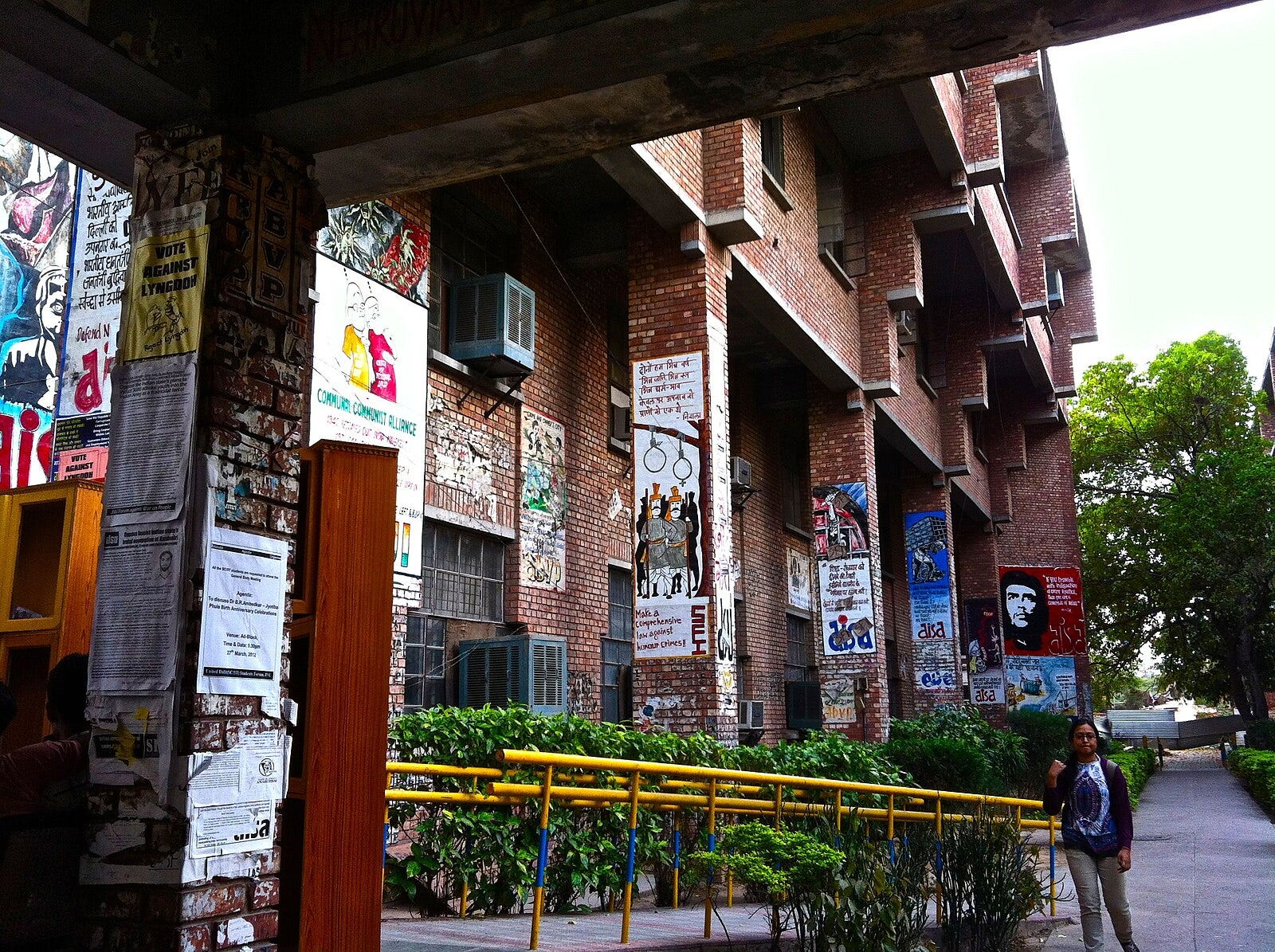
Source: Representative Image of Public University, JNU
https://commons.wikimedia.org/wiki/File:School_of_languages_JNU_Delhi.jpg
Another model, at a larger transnational scale, is the Agrarian South Network, a Tri-Continental initiative (originally from Harare, Zimbabwe) with a strong presence in India, at the Centre for Informal Sector and Labour Studies (CISLS) in JNU. They run the journal Agrarian South: Journal of Political Economy, which foregounds agrarian, environmental, and development crises from the perspective of Global South traditions. They also convene an annual study group, usually from April to October, with monthly online sessions that bring together postgraduate students, faculty, and political activists across Asia, Africa, and Latin America. Past themes include “Colonial Social Formations” and “Historical Materialism”. These are not curated as training programmes, but as intellectual spaces across borders, grounded in collective reading and debate, often in conversation with canonical and contemporary texts.
Together, these initiatives demonstrate that original scholarship is not an accident of individual genius, it is the outcome of careful institutional design. PhD programmes must be deliberate about cohort composition, mentorship structures, and the scholarly communities they foster. Building this takes time. But it is far more productive than simply relying on exam toppers or chasing rankings and memoranda of understanding with foreign universities. The best students may not be the most polished at first, but their instinct and drive can be nurtured, not taught.
We must stop treating PhD programmes as bureaucratic pipelines or holding cells for the unemployed. Their credibility cannot rest on foreign affiliations or shallow signals of being “world-class”. We need more rooted, critical institutions in the spirit of JNU, AMU, and Jamia, spaces that take thinking seriously. This requires working groups, new journals, and a challenge to neoliberal knowledge hierarchies. Not for nationalist pride, but to build intellectual communities worth staying, and returning for.